Stop Chasing Virality. Your Nonprofit Doesn't Need It.
Consistent, mission-focused content builds an audience that sticks around. Virality builds a crowd that leaves.
November 1, 2026
Every nonprofit has had the meeting. Someone brings up a post that exploded for another organization, and suddenly the whole team wants to know how to make one of those.
We understand the pull. Big numbers feel like proof that something is working. But for a mission-driven organization, virality is mostly a distraction, and chasing it can quietly damage the audience you've already built.
What are the odds, really?
The chance that any given post goes viral is about 0.0001%. That's roughly one in a million.
You wouldn't build a fundraising plan around a lottery ticket. Yet a content strategy built around "making something go viral" is exactly that. You spend real staff time and creative energy on something with almost no chance of paying off.
Even when it works, the math is brutal
Say you beat the odds. What happens next?
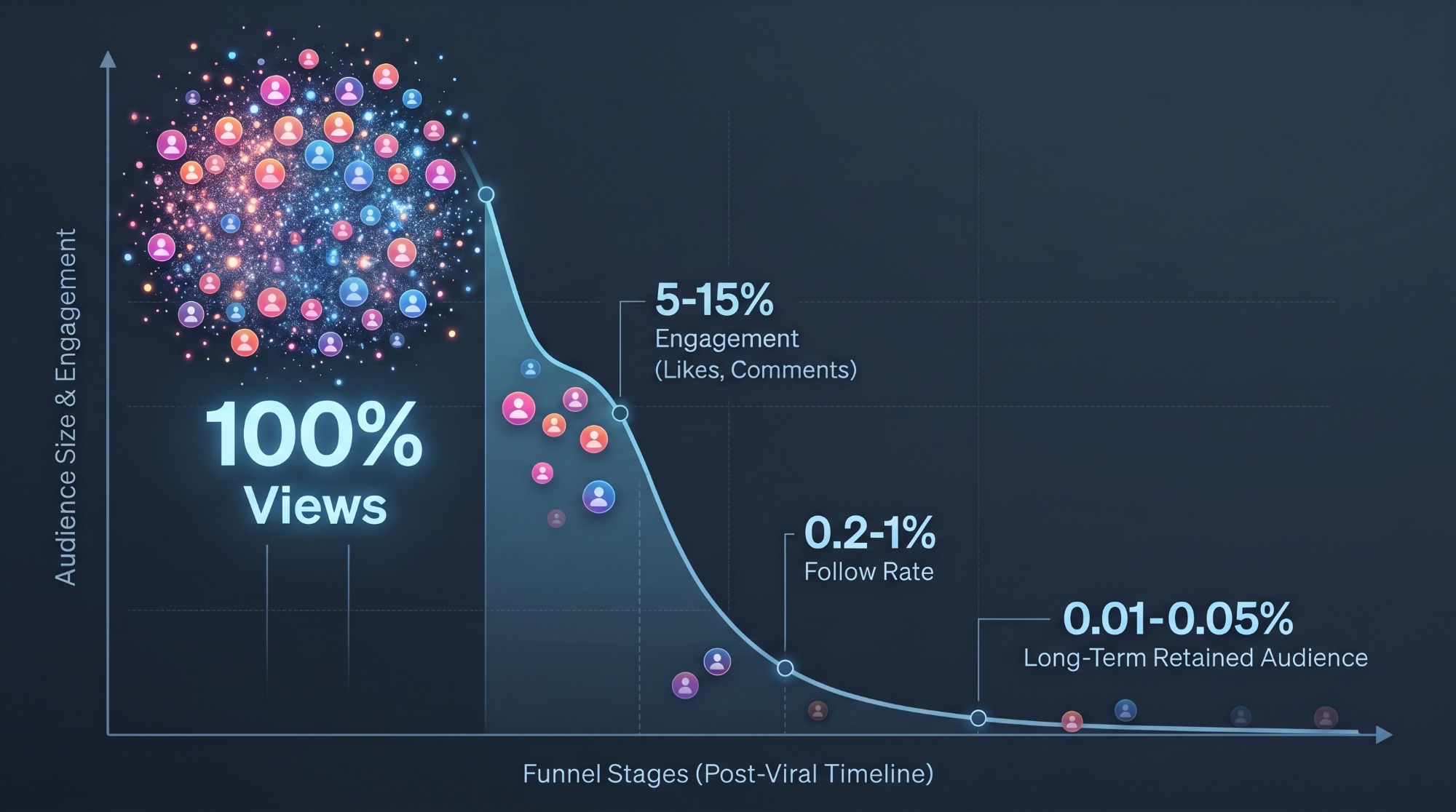
Typically, only 0.2% to 0.8% of viewers click through to your profile and hit Follow or Subscribe. That's roughly 2 to 8 people per 1,000 views. If a post reached 1,000,000 people, that works out to somewhere between 2,000 and 8,000 new followers. That sounds decent until you look at who those followers are.
Of the total original viral audience, the share that becomes permanent, actively engaged fans is usually around 0.01% to 0.05%. That's 1 to 5 people per 10,000 viewers. On that same million views, you'd be looking at roughly 100 to 500 people who actually stick around.
Insight: The vast majority of a viral audience will never care about your organization. They came for the moment, not the mission.
Why a bigger audience can mean a smaller impact
Your existing followers signed up for something specific. They care about your cause, your work, and the particular story you tell.
A viral post usually pulls in people who liked one funny, shocking, or trending thing. They follow, see your regular content, and find it isn't what they came for. They scroll past it or they mute you.
That's where engagement suffers. Your reach and engagement rates can drop because a large share of your audience no longer has any reason to interact with what you post.
So you end up with a bigger number on the profile and a weaker connection with the people who actually give, volunteer, and advocate.
What to do instead: grind
It's not glamorous, but consistency is what builds an audience that's actually yours. Showing up regularly with content that reflects your mission does a few things a viral spike can't:
It attracts the right people. Followers who find you through content about your work are already interested in your work.
It builds trust over time. Donors and volunteers rarely commit after one post. They commit after seeing you show up again and again.
It keeps your engagement healthy. When the audience is aligned with the mission, more of them respond to what you share.
It's repeatable. You can plan a content calendar. You can't plan a viral hit.
Measure what matters
If you stop chasing virality, stop judging your content by it too. Views and likes are easy to count, but they don't tell you whether you're building a community.
Look instead at the numbers tied to your mission:
Are the right people following you?
Are they engaging with your content over time?
Are they signing up, giving, or showing up?
A post that reaches 5,000 people who care about your cause is worth more than one that reaches 500,000 who don't.
The bottom line
If a post happens to take off, enjoy it. Just don't build your strategy on it, and don't change your message to repeat it. With odds this low and a conversion into real fans this small, virality isn't a growth plan.
The nonprofits that win on social media are the ones that keep showing up for the people who already care and keep giving new people a clear reason to join them.